

*I recommend reading the Citizen's Bank Park article first, because it better explains the research.
The gist of my study was that I used Google Earth to measure the distances from home plate to the wall, down the lines and in center field. I made sure Google Earth was correct by measuring the distance from home to the pitchers mound, home to first, and the football field at Lincoln Financial Field. All of those distances were within a foot, so the program is calibrated quite well. I also used some geometry to make sure the distances weren't meant to be to the top of the fence- which I discovered only adds a few inches.
I decided to do this for some other major parks around the league, and what I found is quite interesting.
Yankee Stadium:
Measurements
Left Field- 318 Feet
Center Field- 408 Feet
Right Field- 314 Feet
My Findings
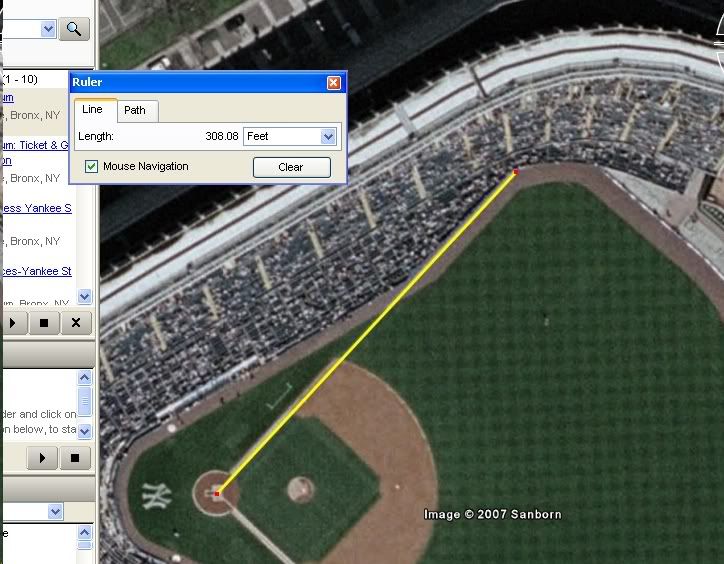
Left Field -308 Feet
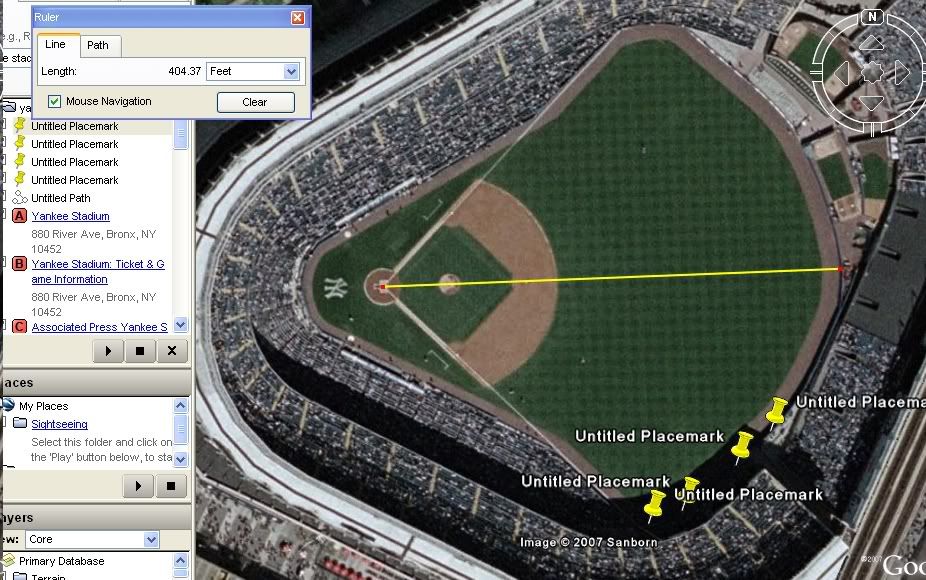
Center Field- 404 Feet
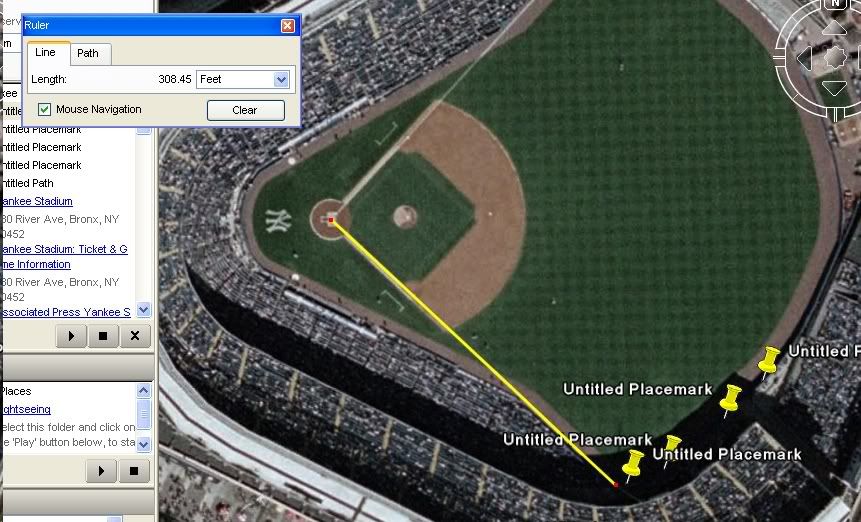
Right Field- 308 Feet
(I placed pins to see where the wall is in the right field corner, because the shadow makes it hard to judge)
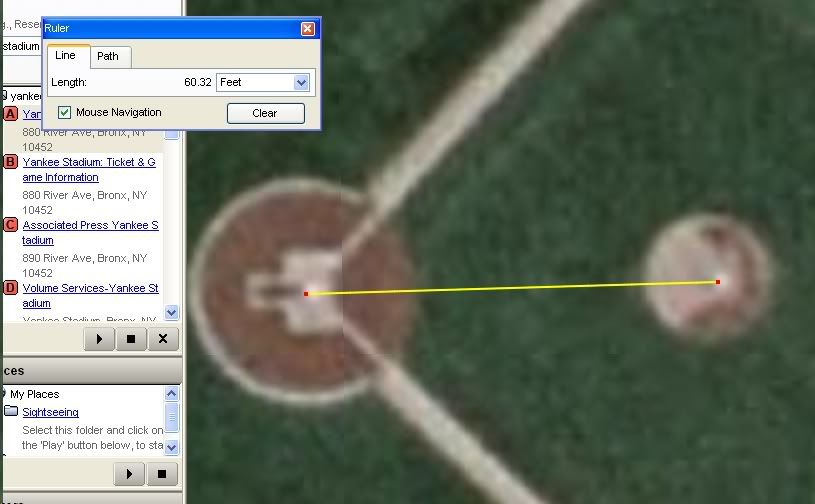
And just to once again make sure the measurement is correct, here is the distance from home to the pitchers mound. Exactly 60 feet.
Fenway Park:
Measurements
Left Field- 310
Right Field- 302
My Findings
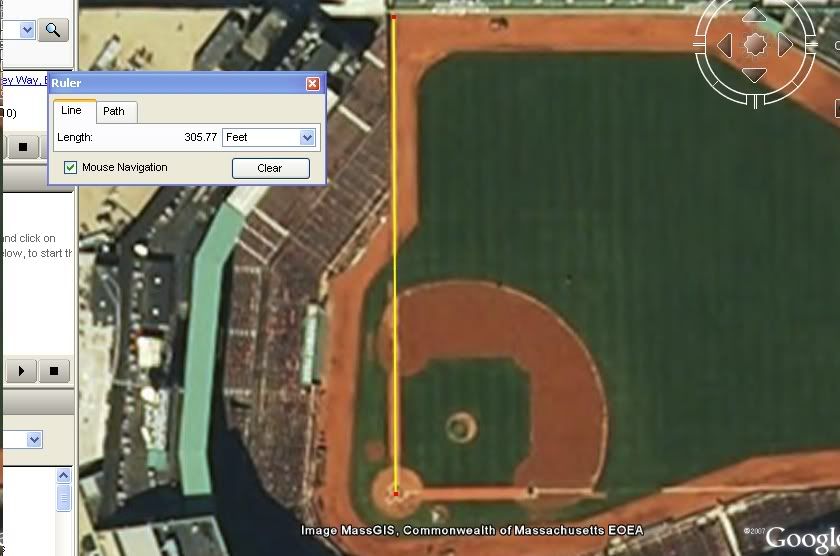
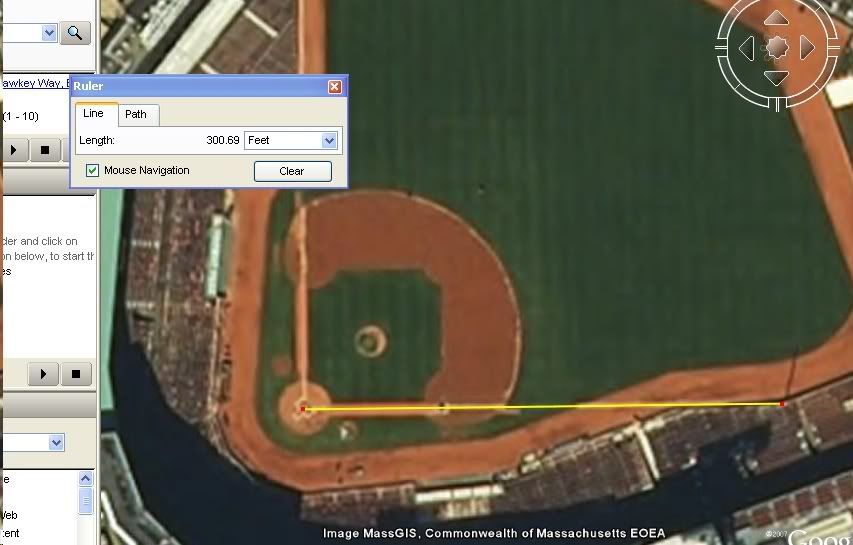
Left Field- 305 Feet
Right Field- 300 Feet
Wrigley Field:
Measurements
Left Field- 355 Feet
Center Field- 400 Feet
My Findings
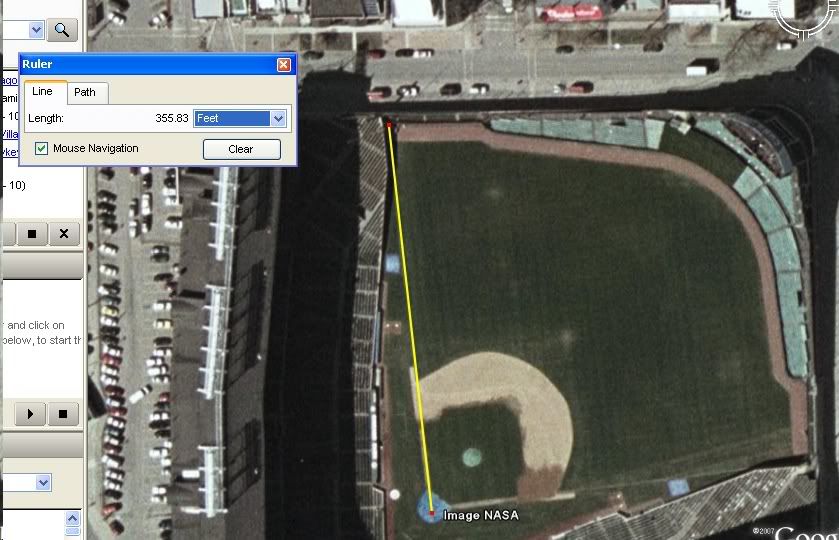
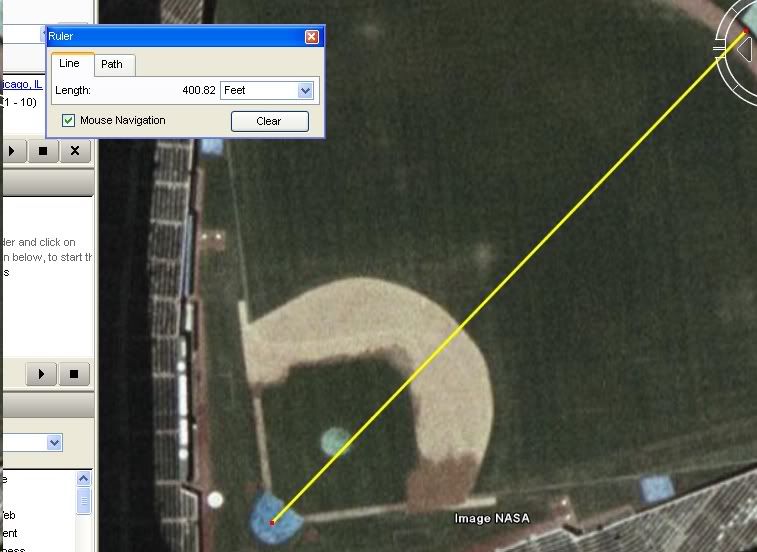
Left Field- 355 Feet
Center Field- 400 Feet
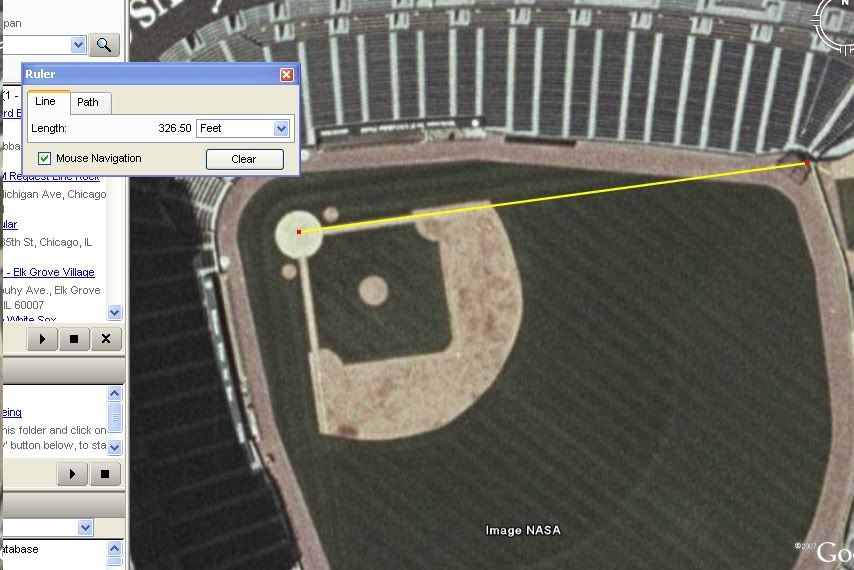
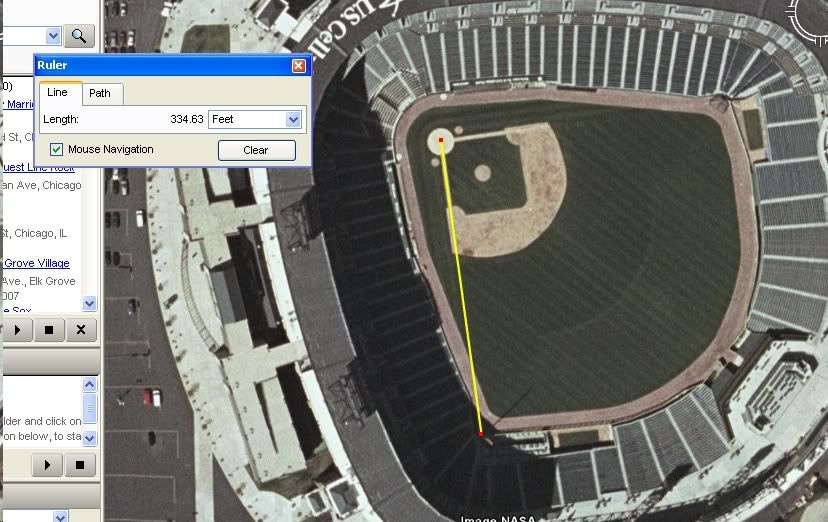
US Cellular Field:
Measurements
Left Field- 330 Feet
Right Field- 335 Feet
My Findings
Left Field- 326 Feet
Right Field- 334 Feet
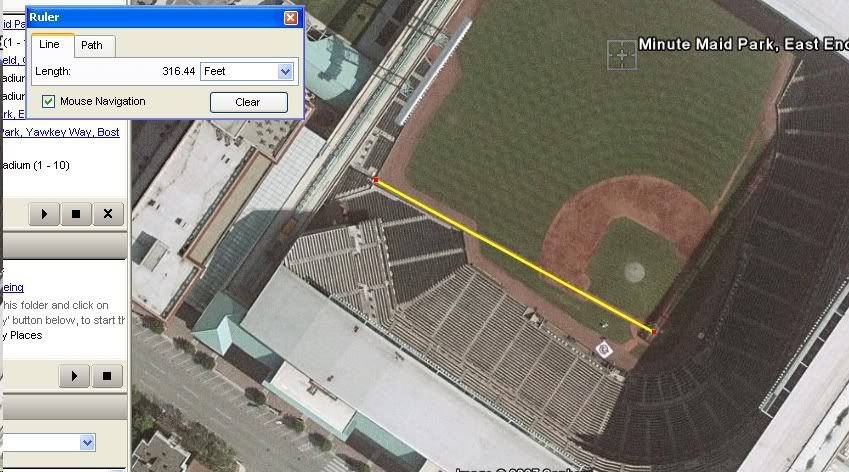
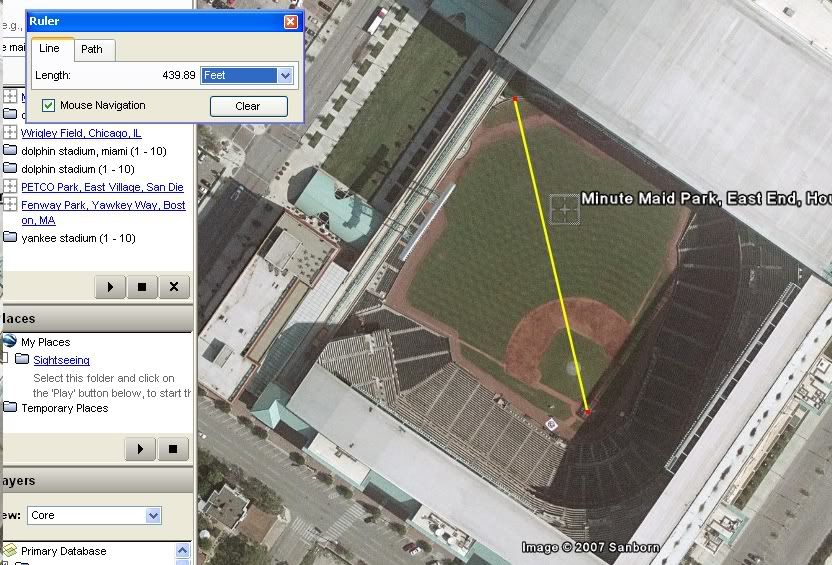
Minute Maid Park:
Measurements
Left Field- 315 Feet
Center Field- 435 Feet
My Findings
Left Field- 316 Feet
Center Field- 439 Feet
Now here is where it gets interesting...
Dodger Stadium:
Measurements
Left Field- 330 Feet
Right Field- 330 Feet
My Findings
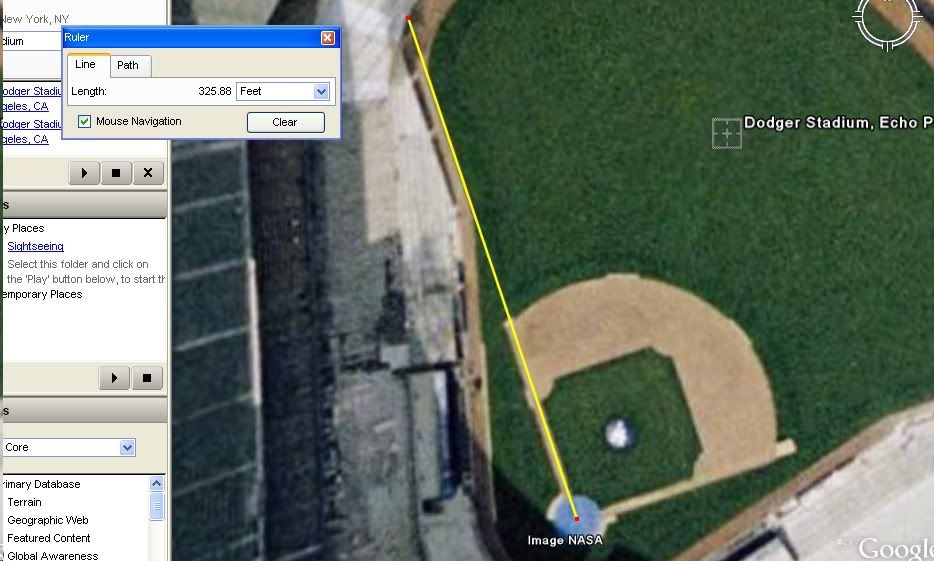
Left Field- 325 Feet
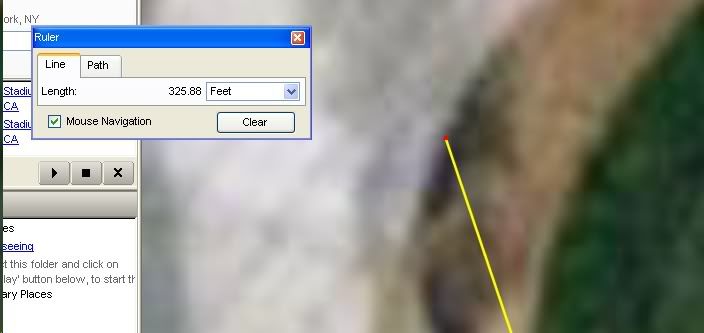
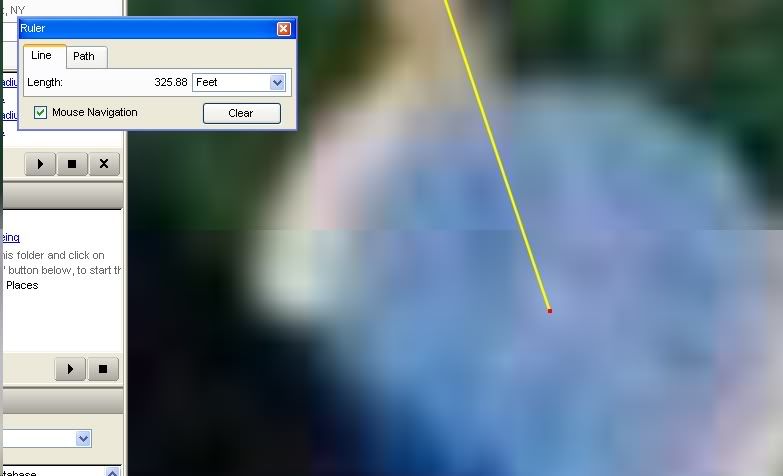
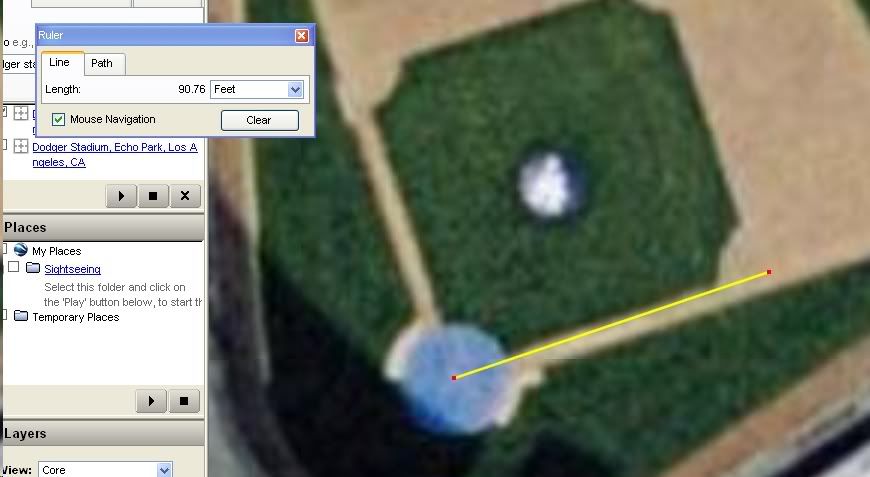
* After looking at this, I compared it to a picture of the new layout, and it appears as if my marker is in the right place, notice how the foul pole is placed just inside where the fence makes a sharp turn and directly in line with the straight edge of the grass. I also zoomed in on the marker HERE and HERE to make sure of proper positioning. So it appears as if the fence is off by 5 feet, but here is where it gets really weird.
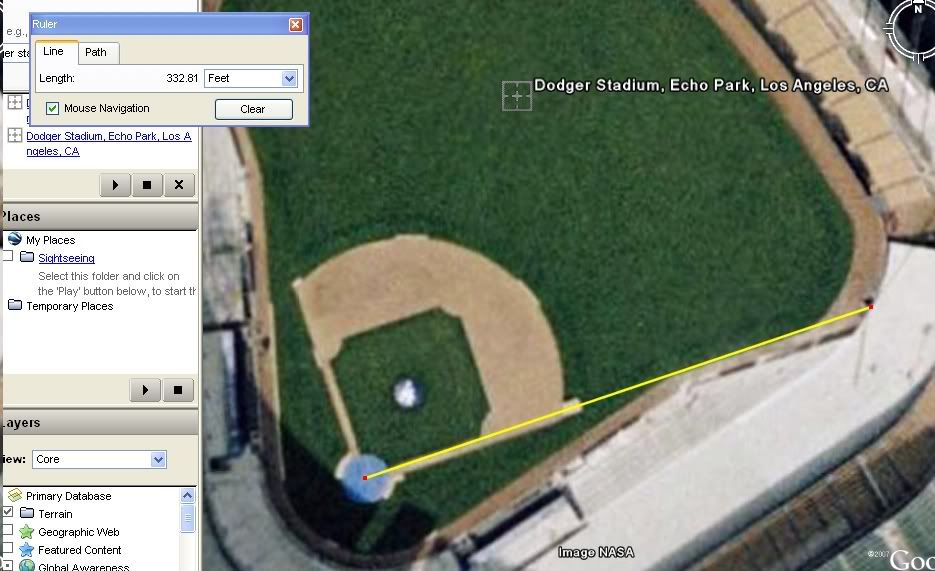
Right Field- 332 Feet
* How is it possible that what is seemingly a perfect arc, can have such a discrepancy in measurements, when my marker is placed as accurately as it can be. I even measured the distance to where first base would be, to make sure the angle in that direction wasn't effecting the distance, but it appears as if that distance is correct.
I'm stumped on this one, but it appears as if the dimensions are slightly off in either direction.
So what does all this mean?
Well, it appears as if some stadiums are grossly short in their official measurements of the walls. Yankee Stadium is off by 10 feet in left field, that is a lot. Fenway Park, which has the most famous left field in baseball, is off by 5 feet. Ironically, Wrigley Field, the oldest ballpark, has the most correct measurements along with Minute Maid Park (which actually underestimated center field, although that hill may play games with the distances). Now, this may or may not have an impact on the distances to the power alleys, but their is really no way to measure that, because the arc could make up for the short lines and because its hard to pinpoint where the exact measurement should be.
Is it a conspiracy theory? No. In cases like Yankee Stadium and Fenway Park, the measurements have been off for years and there is no sense in correcting them. Imagine if the Yankees came out and said, "Actually it is only 308 feet to the left field foul pole, we just realized it after 20 years since the walls were redone." Totally unnecessary. In the case of the Phillies, I think they screwed up to begin with and then, being the secretive organization that they are, they didn't want to admit their mistake. In either case, you wonder what impact some of these distances have had on home runs. If the fence at Yankee Stadium was really 318 feet, how much lower might hone run totals be? We will never know.
A few feet may not seem like a lot, but in a game of inches, it can make all the difference.
FLAWED WALLS: THE MYSTERY OF MAJOR LEAGUE BALLPARK DIMENSIONS
Posted by
Daily D
Wednesday, July 25, 2007

Its an interesting find, but unlikely to make a big scene. Baseball is the only major sport where the playing field is all different shapes and sizes. A home run in left center in Fenway can be a pop up in Yankee stadium. A 20 foot high, 450 long home run to left at Yankee stadium is a long single at Fenway.
I agree, its just interesting that some fences are really shorter than we were led to believe. Again, no conspiracy here, just interesting exaggeration's .
are you also taking into account the height of the OF wall? I dont think Google Earth is going to give you that. I believe that's added to the distance measurement as well, seeing as how the ball has to over the wall to go out.
Wrigley Field isn't the oldest. It was first used in 1914. Fenway opened in 1912.
Joe Science, read the article and you'll see this:
"I also used some geometry to make sure the distances weren't meant to be to the top of the fence- which I discovered only adds a few inches."
why would the top of the fence only add a few inches? If you have a 5 foot high wall and it's 340' the wall, it should read 345' since that's how far the ball would travel if it just barely cleared the top of the fence and there was nothing there to stop it.
I know in the Yankee media guides, there is a list of all the changes in wall distances, so it doesn't surprise me that they are still off.
I know here in Tampa, a few years after the Devil Rays started, the team moved the bullpens from behind the walls. When they did that they realized the dimentions were like 6 feet off on each side. I bet they are still off because I dont think they fixed the alleys. But a very interesting piece.
"I also used some geometry to make sure the distances weren't meant to be to the top of the fence- which I discovered only adds a few inches."
That line makes no sense. It would only add a few inches if the ball came down out of the sky at a very high angle. If, say the ball was it at a 45 degree angle, it would fall at a 45 degree angle, so you would have to add the height of the wall to your measurements. If you add that number you should get the correct measurements. Im pretty sure the people who designed the park and calculated those numbers are smarter than some basement blog writer.
The distance on the wall is exactly that, the distance from homeplate (or it should be), not the distance a ball would have to travel to clear it.
Lets say we have an 8 foot tall wall and it is 300 feet from home plate to the base of the wall. You can figure the distance from home plate (on the ground) to the top of the wall by using the pythagorem theorem a^2+b^2=c^2. A being the distance to the base of the wall (300) b ebing the height of the wall (8 feet) and c being the distance from home plate to the top of the wall. so dong the math we get the distance to be about 300.11 feet, or 300 feet and about 1.5 inches. Even if I made the wall 30 feet, it only adds a foot and a half on the same 300 foot wall.
It's true- just like the radar guns from park to park. An alternate take would be, rather than rely on sat. images, take a Disto or other laser measuring device and measure in person(some have a pythagoreus function that would allow you to triangulate -thus not need to stand at home plate, you could do it from the stands). Bonus - stadiums of baseball road trip. And sorry Joe but 340 feet + 5 feet of wall does not = 345 feet, try some trig. to see.
They add some feet to the distance at the wall because it goes over the wall and if there were not stands or anything else there (landing on the ground) it will would probably travel that much further?
You can zoom in closer at CBP by changing the z= in the link. It goes to 20 maginification, not 19. Probably works at other ball parks as well.
Well, the pitching rubber to the front of home plate is supposed to 60'6", so that may throw all your measurements off according to what the first "exactly 60 feet" statement. It seems to me that you wasted an awful lot of time when you use Google earth. Maybe that whole couple miles in space-thing is hard to compensate for.
Your calibration may be off given that the reference measurement should be 60'6" from the front of the pitcher rubber to the back of home plate (the point) instead of "exactly 60 feet."
a homerun's a homerun. who cares what the number on the wall is.
I did this research and if you click on the Citizen's Bank Park article, you can see that the height of the wall makes very little difference. It only adds inches to the distance. A^2 +B^2 = C^2
http://www.notthegame.com/untitled1.html
Just so you know, the left field line at Fenway used to be displayed as 315'. Rumor has it that a sportswriter broke into the ballpark and measured the distance to be 305'. Apparently, the the Sox compromised, so the distance now reads 310'.
yeah i saw varying reports of 315 and 310, looks like google earth is pretty exact
I think you are correct about some of the fence dimensions, but when you have a satellite photo taken from a bad angle, it will give you bad results, even with their measurement tool. Here's a better overhead of Dodger Stadium:
http://www.hittrackeronline.com/
Dodger_Stadium_overhead.jpg
It has an angle of around 10 degrees away from straight down (my estimate). If you look at the RF and LF lines, the RF line is about 2% longer than the LF line, but the effect of the angle is to compress things in the LF line direction by the cosine of 10 degrees, which is 0.985. So, that accounts for the LF line's apparently being shorter. I believe both lines are essentially the same.
I get similar results in Yankee Stadium, that one has a particularly eccentric photo angle in Google Earth. Try Terraserver.com for some better overheads...